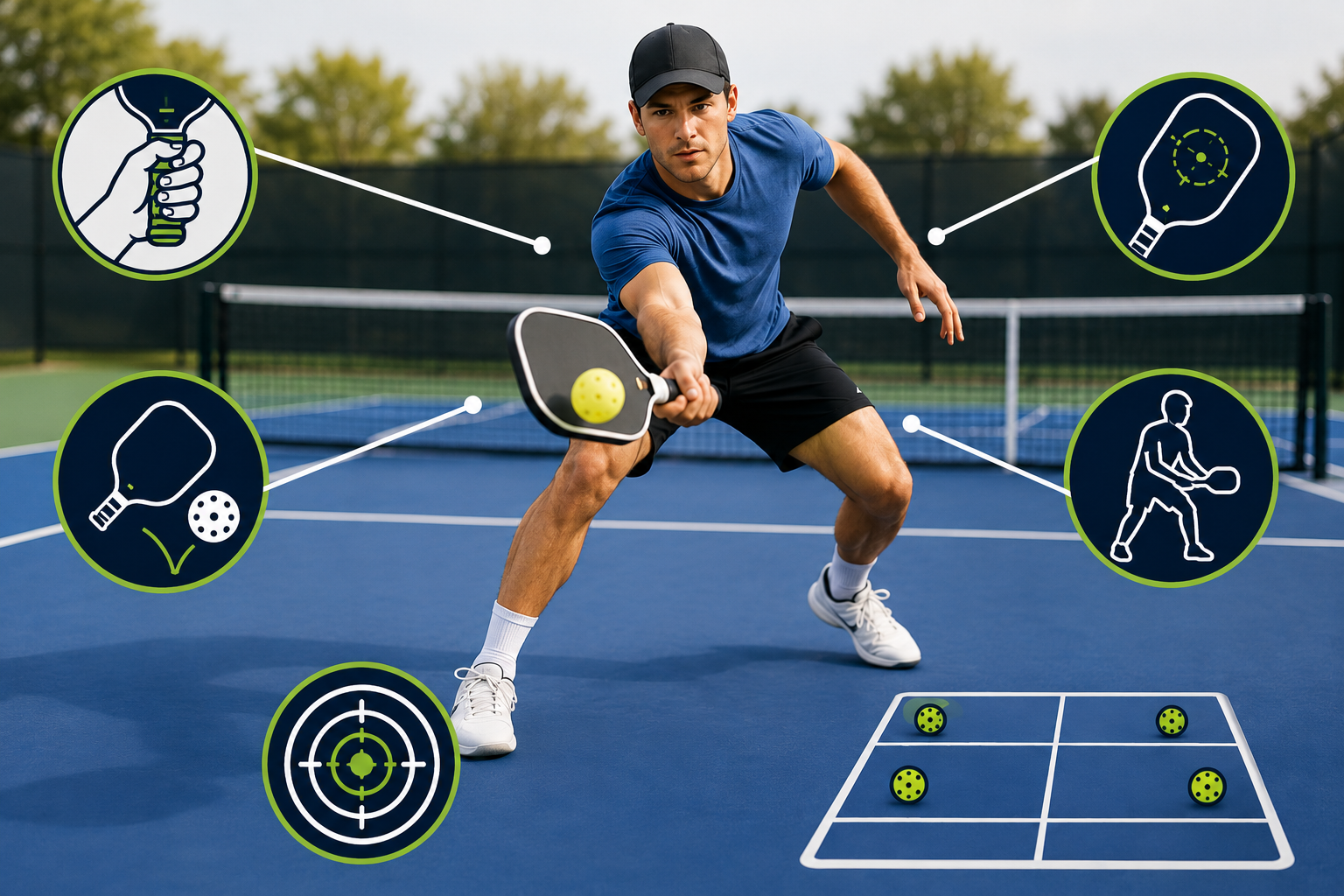
If you want to elevate your pickleball game, paddle control is the lever that unlocks everything else, consistency, placement, and ultimately, winning points. Power is easy to find. Precision is what separates intermediate players from advanced ones. Fortunately, control is highly trainable. Here are five focused, high-impact ways to improve it.
1. Refine Your Grip Pressure (Think “Firm, Not Tight”)
One of the most common mistakes is gripping the paddle too tightly, which leads to grip fatigue, and ultimately, unforced errors. Excess tension reduces touch and limits your ability to absorb and redirect the ball.
What to do:
- Aim for a grip pressure around 4-5 out of 10 during most shots.
- Slightly increase pressure (6-7) only during volleys or fast exchanges.
- Relax your hand between shots, this resets your feel.
- Avoid grip fatigue with our unique HandLok adaptive device. Focus on the game, not your grip.
Why it works:
A looser grip allows micro-adjustments at contact, giving you better control over direction and depth, especially on dinks and drops. In other words, relaxed hands create softer, more accurate shots.
2. Master the soft game first
Control isn’t built through hard drives, it’s built at the kitchen line.
What to do:
- Practice dinking cross-court with consistency as the goal (not winning the rally).
- Work on third shot drops, landing the ball softly into the kitchen.
- Focus on keeping the ball low over the net.
Drill:
Set a goal of 20 consecutive dinks with a partner. If you miss, restart. This builds discipline and touch quickly.
Why it works:
Soft shots force precision. Once you control slow balls, you’ll naturally gain better command over faster ones. As a result, your confidence and consistency during competitive points improve significantly.
3. Improve your contact point
Where and how you contact the ball directly impacts control.
What to do:
- Strike the ball in front of your body, not beside or behind you.
- Keep your paddle face slightly open for softer shots and neutral for drives.
- Maintain a stable wrist, avoid excessive flicking unless intentional.
Why it works:
A consistent contact point reduces variability. The more repeatable your mechanics, the more predictable your shots become. For this reason, advanced players prioritize clean mechanics over flashy swings.
4. Use Your Body, Not Just Your Arm
Players who rely only on their arm tend to lose control, especially under pressure.
What to do:
- Engage your shoulders and core for stability.
- Keep movements compact and controlled, avoid big, sweeping swings.
- Stay balanced, with knees slightly bent and weight centered.
Why it works:
Your body provides structure. When your foundation is stable, your paddle becomes a precise tool rather than a reactive one. Meanwhile, balanced footwork helps you stay prepared for the next shot.
5. Train with Intentional Targets
If you’re not aiming at something specific, you’re not truly training control.
What to do:
- Place cones or visual targets on the court (deep corners, sidelines, kitchen zones).
- Practice hitting specific zones repeatedly, not just “in bounds.”
- Alternate targets to simulate real match decision-making.
Drill:
Hit 10 balls aiming for the deep backhand corner, then switch to the opponent’s feet at the kitchen line.
Why it works:
Control is directional. Targeted practice builds the neural pathways needed for accurate shot placement under pressure. Ultimately, intentional repetition is what transforms practice into real match performance.
Final Thought
Paddle control isn’t about doing one thing better, it’s about doing several small things consistently well: grip, touch, positioning, body mechanics, and intentional practice. When these elements align, your game becomes smoother, more strategic, and far more effective.
If you build your game around control, power becomes a tool, not a crutch.